
Feature
Tips to make the news more accessible
By Patrick Garvin, independent journalist and accessibility consultant I’ve spent more than four years speaking at journalism conferences and talking to newsrooms about making news sites more accessible to people with disabilities. When I speak with journalists about this, I rely on two sets of credentials: the accessibility certifications I’ve earned in the last four…
Read MoreSources and Sexual Harassment: Advice for Reporters and Editors
By Bethany Barnes Editor’s Note: This story originally appeared in the IRE Journal Quarter 3 issue. Members can download and read the full issue here. Non-members can purchase for $20. A few months into my first journalism job, I met a source at a bar. I’d met sources at bars before, including this particular source,…
Read MoreThe Newsroom Guide: A living document shapes inclusive language, coverage

By Lynn Jacobson, The Seattle Times Between December 2015 and June 2017, The Seattle Times had several opportunities to practice the art of the apology. In that period, the newspaper made a number of high-profile missteps. Among them: a headline that portrayed the black victim of a police shooting in a negative light, and a…
Read MorePublication without representation

By Ron Nixon, The Associated Press In 1895, journalist Ida B. Wells dropped a bombshell investigation into the lynching of African Americans across the nation. Using data she gathered from accounts in white newspapers — she said no one would believe her otherwise — “The Red Record” showed lynchings were not in response to rape…
Read MoreHow to be an ally in the newsroom

Five journalists share tips and ideas for creating a culture of inclusivity, regardless of job title, in their newsrooms. Ashley Graham, WLNS (Lansing, Michigan): “It’s important for everyone in the newsroom to be open to ‘diverse’ story pitches. Many journalists of color find that pitches related to their respective communities get turned down for being…
Read MoreEthical Source Development
By Aidan White, Ethical Journalism Network The relationship between journalists and their sources is complex and full of ethical pitfalls. In the provocative opening to her splendid 1983 book onthe subject, “The Journalist and the Murderer,” Janet Malcolm targets deceptive journalism: “Every journalist who is not too stupid or too full of himself to notice what…
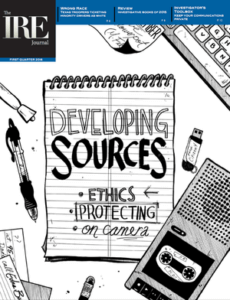
Read MoreDeveloping Sources
By Bernice Yeung There are many lessons about journalism to be learned from “Spotlight,” the film that chronicles The Boston Globe’s investigation into the Boston Archdiocese’s systemic cover-up of child sexual abuse by Catholic priests. As the story behind the story, “Spotlight” highlights themes that are especially instructive to investigative reporters: That there’s the unspoken…
Read MoreInvestigative Books of 2015: “Ghettoside” leaves lasting impression
By Steve Weinberg With so many superb investigative/ explanatory books published by U.S. journalists during 2015, singling out just a few to this year’s IRE investigative book list feels daunting. That is true every year, but for reasons I cannot decipher precisely, the year 2015 felt more that way. Certainly, the impressive quality and quantity…
Read MoreCrammed Quarters: Exposing inequities of female student housing in Yemen

By Shada Hottam, Arab Reporters for Investigative Journalism The idea of investigating “Nightmare Dorm at Sana’a University” started after I enrolled at Sana’a University to study TV and radio journalism in 2010. Over the years, I came to hear from my female colleagues about the horrible conditions they lived in at the dormitory, the only…
Read MoreInvestigative reporter sentenced to prison

Today investigative reporter Khadija Ismayilova was sentenced to seven-and-a-half years in prison in the country of Azerbaijan. According to one of Ismayilova’s employers, Organized Crime and Corruption Reporting Project, Ismayilova was found guilty of embezzlement, tax evasion, abuse of power and running an illegal business. OCCRP reports that human rights groups believe Ismayilova’s conviction is…
Read More