
IRE Conference Blog
Humans of IRE: Meet a few of the Philadelphia conference attendees

A record number of journalists turned out at the annual IRE Conference in Philadelphia this year, so we thought it would be fun to get to know some of our 1,800 attendees. We asked a few of our 2015 IRE Conference Knight Scholars to talk to attendees and share portions of their conversations on this…
Read MoreFrom facts to data: Tips for making your stories airtight
By Taylor Bembery According to the Society of Professional Journalists Code of Ethics, a journalist is required to seek and report the truth. At the Investigative Reporters and Editors Conference in Philadelphia, journalists discussed methods for making stories airtight. The panel was moderated by Shawn McIntosh of The Atlanta Journal-Constitution and included panelists, Alleen Brown…
Read MoreHow to write an unforgettable data story
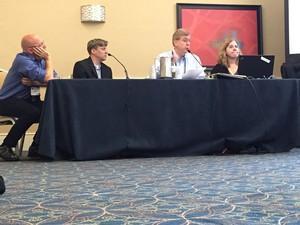
IRE attendees learn how to effectively use data in their stories from a panel of award-winning journalists Photo by LaCrai Mitchell By LaCrai Mitchell “Just make sure if you fail, you did what you wanted to do.” At face value, this David Letterman quote is completely unrelated to telling a good data story. However, during…
Read MoreTeam players: How to navigate a multi-newsroom investigation
By Cynthia Ferraz Hailed by moderator Ellen Weiss of Scripps Washington Bureau as “champions of partnerships,” John Kelly of USA Today; Marina Walker Guevara of the International Consortium of Investigative Journalists (ICIJ); and Richard Pienciak of The Associated Press offered tips and presented an overview of managing partnerships within a multi-newsroom project at the 2015…
Read MoreGive your investigation a twist using ‘solution journalism’
By Darian Muka Panelists David Bornstein, Greg Borowski, Tina Rosenberg and Claudia Rowe spoke about the power of solution journalism during a panel at the 2015 IRE Conference. Dubbed “solution journalism,” positive deviants frame an issue around improvements or best practices. “The idea is that you’re going to create a lot of awareness and outrage…
Read MoreVeteran broadcast journalists share tips on story structure
By Brittany Collins Structuring an investigative news story is important. Not only does it help prevent confusion for viewers, but it also allows the reporter to get creative when putting together various elements of the story. Solly Granatstein from The Weather Channel, Brendan Keefe from WXIA-Atlanta, Chris Vanderveen from KUSA/9News Denver, and Matt Goldberg from…
Read MoreNew avenues for reporting on climate change and other global crises
By Pietro Lombardi The number of enterprise stories covering climate change, illegal resource exploitation, food and water security and other environmental threats has increased in recent years. Deborah Nelson, Pulitzer Prize-winning journalist and freelance investigative reporter for Reuters; Robert S. Eshelman, Environment Editor at VICE News; Andrew Revkin, Pace University, and Josh Meyer, Medill National…
Read MoreTips for reporting on diverse communities that aren’t your own
By Amber Liu Trying to excel at covering diverse communities might include new techniques or resources, such as collaboratively developing a diverse source list and rethinking how to best use interpreters. Sherry Yu of Temple University, Michael Matza of The Philadelphia Inquirer and Sabrina Vourvoulias of AL DÍA News suggested these techniques and more at…
Read MorePipelines, dams and pollution: How to investigation the environment in your community
By Lenore T. Adkins Some of the most important stories about the environment lurk beyond the city limits, but reporters often overlook those narratives because they aren’t in urban settings, said a group of panelists who investigate the environment. “Agriculture is vastly under-covered,” said Joseph Davis, editor of the WatchDog newsletter for the Society of…
Read MoreBeyond words: Storytelling at the intersection of cool & creative
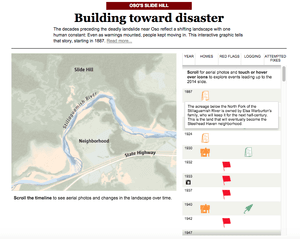
The Seattle Times built an interactive graphic on the Oso landslide By Albert Hong “For me, doing this panel is a real treat because it means, for once, I get to hang out with the cool kids,” Ken Armstrong, staff writer at The Marshall Project, said as he kicked off an IRE Conference session on…
Read More