
IRE News
New webinar: Watchdogging Lions, Tigers, Bears, et al: Inside college sports
Jill Riepenhoff of The Columbus Dispatch shares tips on investigating college sports, from how to examine the rule book and find story ideas to using the NCAA’s infraction database and digging into athletes’ mysterious departures from their teams. Watch it here. Riepenhoff has worked at The Columbus Dispatch since 1985 and as a projects reporter…
Read MoreThe details of uncovering performance-enhancing drug abuse
T.J. Quinn leads discussion on “Performance Enhancing Drugs” as Michael Fish looks on. Photo: Travis Hartman. Major League Baseball continues to deal with its performance-enhancing drug issue and the fallout from lengthy suspensions to some of the games most prominent players, such as Ryan Braun and Alex Rodriguez. Want to find out how it got…
Read MoreGlobal Investigative Journalism Network launches crowdfunding campaign
The Global Investigative Journalism Network today launched a new crowdfunding campaign, raising funds to bring promising journalists from developing countries to the Global Investigative Journalism Conference and provide them with state-of-the-art training in investigative reporting, data journalism and cross-border collaboration. The crowdfunding campaign is done through Indiegogo, and the campaign video features reporters in Kenya,…
Read MoreAssessing and mapping dangerous intersections, traffic fatalities in your community

A still image from the Orlando Sentinel’s Blood in the Streets animated video. By Scott Powers and Arelis Hernandez, the Orlando Sentinel This past winter, after an Orlando Sentinel editor almost ran down a pedestrian for the umpteenth time – a moment which occurred about the same time that our breaking-news desk had to write…
Read MoreNew webinar: Search strategies, sites and databases for investigative reporting

Watch now: Search strategies, sites and databases for investigative reporting Google’s not the only search game in town. Learn about search sites that provide different pools of information and unique features. Discover resources to help with people finding, fact-checking and social search in the surface and the deep Web. Barbara Gray, Distinguished Lecturer & Interim…
Read MoreWhen nerds and words collide
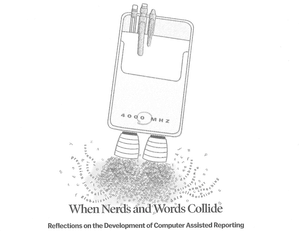
In 1999, Nora Paul organized a gathering at The Poynter Institute of a group of journalists who were on the cutting edge of computer-assisted reporting at the time. The result was a short book titled “When Nerds and Words Collide,” featuring chapters from many leaders in data-driven journalism. It also details the beginning of what…
Read MoreNew webinar: Spycraft for journalists
Watch now: Spycraft for Journalists Keep your sources and your secrets safe from prying eyes. In IRE’s latest webinar, Steve Doig, Knight Chair in Journalism at Arizona State University, explains spycraft for journalists. This webinar covers the use of cryptography, spoofing caller ID, anonymous email, throwaway phones, steganography and other covert techniques for communicating with…
Read MoreHow journalists can learn safer communication and improve online security
The New York Times Magazine this week profiles documentary filmmaker Laura Poitras and her role in helping National Security Agency contractor Edward Snowden leak thousands of classified documents regarding government surveillance programs. From the magazine: Poitras possesses a new skill set that is particularly vital — and far from the journalistic norm — in an…
Read MoreHow reporter Steven Hsieh stumbled across his first investigation
Reporter Steven Hsieh was never informed about a dangerous landfill in his hometown of West County in St. Louis until one day while watching cable news. Hsieh, one-year out of school at the Missouri School of Journalism, stumbled upon a broadcast of a roundtable discussion in which Diane Schanzenbach, associate professor in the School of…
Read MoreDespite publicity for transparency, fear and self-censorship in Tanzania

Anti-press attacks are generating fear and self-censorship among journalists in Tanzania, according to a report published Wednesday by The Committee to Protect Journalists. Despite good international publicity for moving toward an open government, public discontent remains largely unseen and unheard. CPJ’s findings include 10 serious anti-press attacks since September, which is “a notable jump over historical trends…
Read More