
Posts Tagged ‘data’
Ten irrefutable and nonnegotiable rules of responsible data journalism
Few things in life (and journalism) are literally irrefutable and nonnegotiable. But we think this list comes pretty close. Journalists who use data come from a variety of backgrounds and have a wide spectrum of resources, skills, and time to do the work. Regardless of these differences, we’ve put together some simple rules that apply…
Read MoreBehind the Story: Two Cleveland reporters raise the issue of rape kits that sat untested for 20 years
Rachel Dissell and Leila Atassi wanted an answer to a seemingly simple question: how many untested rape kits did the Cleveland Police Department have in storage? The answer: “We don’t know.” The reporters’ question prompted Ohio Attorney General Mike DeWine in 2011 to ask all Ohio law enforcement agencies to send their rape kits to…
Read MoreIRE to keep Data Library OPEN during Government Shutdown
The government has shut down; national parks and museums are closed. Some million federal workers stayed home. Even some government data portals, such as data.gov and census.gov, have been shuttered. But don’t fret. The NICAR database library provides access to dozens of government databases at a time when federal agencies across the world wide web…
Read MoreReporter finds hundreds of unpunished water violations in Minnesota
By Mark Steil, Minnesota Public Radio I’ve always enjoyed looking through large piles of data in my job as a reporter for Minnesota Public Radio. My primary beats are the agriculture and energy sectors. I’ve been on the job 35 years now, and for most of that time a document hunt generally meant one thing:…
Read MoreWhy a recent journalism school graduate spent her money on a drone

An aerial shot of the Balboa Fun Zone in Newport Beach, California. Photo by Sally French When I told my parents I was using my graduation money to buy a drone, they thought I was crazy. “Why don’t you buy some camera gear instead?” they told me. After all, graduating in May with a photojournalism…
Read MoreLaCrosse Tribune reporter turns IRE training into data-driven stories for community
In March, LaCrosse Tribune reporter Chris Hubbuch attended an IRE training event in Wisconsin, where introductions to Excel and data-driven journalism were on the agenda. Since then, he’s produced data-driven stories on foreclosures, property values, crime and waste. He even revelaed that the LaCrosse mayor’s pet license was out of date. Using federal data, the…
Read MoreOnline data and tools for environmental investigations
By Gwen Girsdansky Lisa Song of InsideClimate News, Ingrid Lobet of the Houston Chronicle, David Sheppard of the San Antonio Express-News and Jim Morris of the Center for Public Integrity gave suggestions for online resources available for investigating environmental issues on Thursday at the IRE Conference. Lobet mentioned a good tactic is thinking about what…
Read MoreGetting access to information inside prisons
By Perla Arellano There are many stories behind prison bars. Prison gangs, medical care, autopsy records, and flawed prison programs are just a few of the ideas offered at a panel sponsored by Criminal Justice Journalists. But getting access to the information inside prisons to build the story at some times may seem impossible. …
Read MoreDealing with inaccessible data and finding a needle in a million haystacks
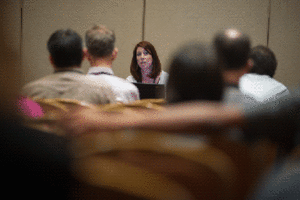
By Jordan Gass-Poore’ Amanda Zamora of ProPublica answers questions during a panel on how to build a thorough data-based investigation with inaccessible, incomprehensible, and indeterminate data. Photo: Travis Hartman. Leading journalism professionals spoke about the search for finding meaning in messy data during Thursday morning’s session “Finding the needles in a million haystacks: How to build…
Read MoreYou’ve got the data, where’s the story? How to find interesting patterns and do analysis
By Kathryn Sharkey Data can be overwhelming, so when it comes to finding the story in it all, Dan Keating from the The Washington Post and Jacob Fenton from the Sunlight Foundation agree: start small. Review the information and look for what’s interesting and jumps off the page. Fenton’s three-step guide to a story is…
Read More