
Posts Tagged ‘inequality’
IRE Radio Podcast | The Graduates

On high school graduation day, the future looks bright, especially for Boston’s valedictorians. But as years pass, things come to look quite different for the city’s top students. A quarter of them didn’t finish college within six years. Many wanted to be doctors, and today, none of them are. On this episode, Meghan Irons and…
Read MoreGo beyond surface-level coverage when writing about inequality
By Raven Nichols From achievement gaps to the disproportionate impact of the mortgage crisis, the story of inequality takes many different shapes and forms. Holly Hacker, Kimbriell Kelly, Burt Hubbard and Malik Singleton offered tips at a panel on Saturday morning about how journalists can best investigate inequality. Hubbard, a Rocky Mountain PBS journalist, spoke…
Read MoreInvestigating racial inequality: Dig deeper and stop obsessing over intent
Find this story in the latest issue of the IRE Journal By Nikole Hannah-Jones | New York Times Magazine The last year has been a particularly tumultuous one when it comes to race in the United States. We’ve seen riots in two cities following the police killings of unarmed black men. There have been nationwide protests…
Read MoreCrammed Quarters: Exposing inequities of female student housing in Yemen
By Shada Hottam, Arab Reporters for Investigative Journalism The idea of investigating “Nightmare Dorm at Sana’a University” started after I enrolled at Sana’a University to study TV and radio journalism in 2010. Over the years, I came to hear from my female colleagues about the horrible conditions they lived in at the dormitory, the only…
Read MoreInequality is not magical, and other takeaways from top journalists reporting on race issues
By Moriah Balingit In the past year, incidents of police brutality and fatal police shootings have served as a flashpoint for discussions on race in this country. And rightfully, much of the discourse has been centered around those events: the details, the characters, the protests and investigations in their aftermath. But how do journalists move…
Read MoreReporting on inequality requires an eye for historical context, institutional injustice
By Laura Rena Murray Sally Lehrman of the Markkula Center for Applied Ethics and Venise Wagner of San Francisco State University discussed reporting tools and strategies to better cover institutional inequity. Wagner and Lehrman began the session with personal tales. Lehrman’s great-grandfather moved to Colorado to be cured of tuberculosis in a sanitarium – prevailing…
Read MoreInvestigating income inequality with the Gini coefficient and other data
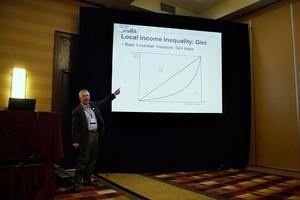
Paul Overberg, of USA TODAY, points to a graph of the Gini Index, which is a measure of income inequality. The diagonal line is perfect distribution of income and the curved line is a representation of actual distribution income. Overberg is interested in the space between them and what it describes. Photo by Travis Hartman.…
Read More