
Posts Tagged ‘lawsuit’
Best practices for investigating litigious billionaires
By Taeler De Haes We live in a world of billionaires who exert quite a bit of influence over our lives, especially as reporters. At the recent IRE Conference in New Orleans, a panel of investigative journalists discussed getting sued by billionaires, including Donald Trump. They gave tips on how to bulletproof their work, defend…
Read MoreHow two court rulings involving universities breathe new life into the right to know
By Jonathan Peters, CJR.org Editor’s Note: This article first ran on March 23, 2016 on the Columbia Journalism Review’s website. Sunshine Week brought some welcome news for transparency advocates this year: Two state courts ruled, in suits brought by news organizations, that freedom-of-information laws require private entities to disclose their records if they perform a…
Read MoreStrategies for getting the data and documents you need
By Quint Forgey In our seemingly endless quest to obtain government documents, it’s important to recognize and alleviate the often tense relationships between reporters and public information officers. During Friday’s panel discussion, “They’ve got it, you want it: Getting data and docs,” Rich Orman, senior deputy district attorney of Colorado’s 18th Judicial District, said bureaucrats…
Read MoreVirginia’s secret police: A fight to hold law enforcement accountable

By Gary Harki, The Virginian-Pilot In February, the Virginia Senate passed a bill that would allow law enforcement agencies to keep secret the names of all police officers, deputy sheriffs and fire marshals. It eventually died in a House subcommittee, but only after journalists raised the alarm that the state of Virginia was about to…
Read MoreScrutinizing what you scrape: How The New York Times investigated arbitration
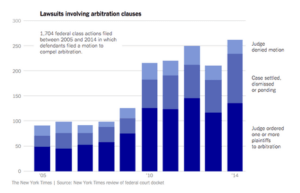
A graphic from The New York Times’ arbitration series Court records have long been a vital tool for journalists looking to hold powerful corporations accountable. But what happens when disputes between companies and consumers move out of open court and into private meeting rooms? What happens when class action lawsuits – and the wealth of…
Read MoreIRE Radio Podcast | ICE’s Secret List
What happens to immigrants convicted of sex crimes? The answer, Maria Sacchetti found out, is often unsettling. Her investigation for the Boston Globe revealed that Immigration and Customs Enforcement (ICE) was quietly releasing violent offenders back into the U.S. when their home countries wouldn’t take them. On this episode, Sacchetti talks about the reporting process…
Read MoreJudge: Missouri broke the law by concealing execution drug supplier
By Allison Wrabel Cole County Circuit Court Judge Jon Beetem ruled that the Missouri Department of Corrections violated the Sunshine Law when it failed to reveal the name of the pharmacy that supplies the drugs for lethal injections. Under state law, the identities of individual execution team members are to be kept confidential. In 2013,…
Read More3 ideas for covering America’s booming prison population
The United States is a world leader in incarceration, with more than 2 million people in prisons and jails. At the 2014 IRE Conference Barry Krisberg, a senior fellow at UC Berkeley Law School, discussed a handful of trends for journalists to follow in the coming year. Here are three to keep an eye on:…
Read MoreBehind the Story: New Jersey reporter finds inconsistencies in 2008 death investigation

Chris Baxter Chris Baxter and NJ Advance Media wrestled out a compelling and untold story, let the digital presentation take the lead and came away with a “smashing” investigative success. Using a system he developed to keep tabs on lawsuits involving state police, Baxter came upon the stifled story of Kenwin Garcia, a Newark man…
Read MoreJudge blocks Alabama newspaper from printing information obtained through open records request
A state court judge has temporarily blocked the Montgomery Advertiser from publishing information about a utility company’s plan for gas line safety, information obtained through an open records request. Alagasco says the Distribution Integrity Management Plan, released to the newspaper by the Alabama Public Service Commission, contains proprietary and safety-related information that could jeopardize public…
Read More